Friday, August 25, 2006

Brian Reaves, author of Stolen Lives


MY REVIEW:
Revenge: it’s a powerful force that can destroy a life. Don’t believe it? Just ask Robert Whitney, owner of a Birmingham-based software company. His wife and daughter were killed when trucker Derek Morrison purposely changed lanes and totaled their car. And part of Robert has died with them.

Matters only worsen when Robert discovers that deceit played a part in Derek’s absolution. Past the edge of sanity, Robert uses his computer knowledge to take the law into his own hands and ruin the lives of Derek and others involved. His mission in life is to make them suffer just a portion of what he has suffered. But will it be enough?

This novel is first-class, hopefully the first of many more to come. Contemporary in nature, relevant in theme, frenetic in pace, I literally could not put the book down until I finished it. The same day I started it. Brian Reaves has taken a plausible story and put it into overdrive. Ample suspense is built throughout as the stakes are continually raised in several characters’ lives.

My favorite character was a man named Levi. I won’t give away his role, but I will say that he is a paradox, an unlikely breeze that blows fresh air into the whole book. I can only pray there are really people like that in the world.

Brian Reaves is definitely a force to be reckoned with in the world of fiction. He knows how to draw the reader in, and once he’s got you, he doesn’t let go.


INTERVIEW QUESTIONS:

1. How did you get the idea for Stolen Lives?
The car wreck in the story is based on a real one in Birmingham several years ago. While the family didn't die, they were pulled under a transfer truck when it pulled into their lane. The State Trooper, for whatever reason, listed the accident as the car's fault even though the truck veered into them. It got me thinking, what if a guy had lost his family in the wreck and it was made to look like their fault? What if he decided to get revenge on the people responsible? And then I thought, what if he was a hacker and wanted to get creative in his revenge? The more I researched about identity theft and social engineering, the more I realized how dangerous someone could be if they knew what they were doing. It might even be possible to get revenge and never even be caught. The story itself flowed from that seed.

2. You're a computer programmer. Obviously, that knowledge helped you out in your research for this book. What other things/circumstances in your life have prepared you for writing this book?
I love to read everything from suspense novels to comic books. If I could say anything prepared me for writing this (or any other book) it would have to be the great stories I've read from other authors. That thrill of being pulled along helplessly as the writer hurls the characters from one problem situation keeps me glued to a book until I'm finished. That feeling--that rush--is what I shoot for.

I did a lot of research into social engineering as well. It was funny because the more I studied it, the more suspicious I became of even the little things like phone solicitors. I talked to a few "white hat" hackers (the good guys who try to get into systems to help a company find the leaks in their networks before the bad guys do), and found their world fascinating. I even went so far as to try and social engineer my way into a few situations just to make sure I was being realistic. I didn't do anything illegal, but it's amazing how easily some people are fooled.

I'm also an amateur magician, and a black belt in Tae Kwon Do. Both of those played parts in developing the Ian character in the story. My love of comic books plays heavily in my next book. :)


3. You're on staff with Infuze magazine (which I love, btw). Tell us a bit about that and how it came about.
I actually got involved back when it was known as "Fuse Magazine". I submitted a short story and got a lot of encouragement from Robin Parrish (the editor) about it. He compared me to Ray Bradbury and Neil Gaiman, and it was the biggest compliment I could have gotten. I kept sending in stories, and then they started looking for reviewers. I jumped on board with that, and have recently moved to doing a couple of interviews as well. I even got to interview one of my favorite authors of all time thanks to InFuze! It's been a lot of fun watching it mature into the amazing website it is today.

4. Have you always wanted to be a writer?
I think anyone who has ever read a book by choice (and not forced to for a class at school or something) has at least considered the possibility of seeing their name in print. I tried writing my first short story after reading This Present Darkness by Frank Peretti when I was a teenager. While that story wasn't very good, it was a first effort. I started seriously considering the possibility of being a writer in my early twenties, but never realized how much work went into writing a book. I wondered why authors only put out one novel a year most of the time. I mean, it seemed like a fairly easy thing to do when you wrote a book...no more than a couple of weeks at the most. I was so wrong! It took me three years to finish my first novel, and Stolen Lives took me about two years. I finished my last one in eight months, and it looks like that's about how long it will take to finish my current one, so I think I've hit my stride now.

5. Explain the relationship between your faith and writing. How do they intertwine?
Some authors get upset when you brand them a Christian writer. They want to be "a writer who happens to be a Christian", but not "a Christian writer". I've never understood that. When you've been given this awesome platform by God to encourage other people, why on earth would you not use it? No matter how dark my stories become, I always try to show the light of Christ in the end. And while I have no problem writing a short story that's just a fun read and not a Christian one, I always keep it within certain boundaries. I am a Christian, and I write stories...and I'm not ashamed to say it. You can tell a great tale and not use filthy language or graphic sex to keep readers interested.

That being said, there are actually parts of Stolen Lives that I feel are too preachy. It didn't seem that way at the time, but looking back on it I realize there were some places I could have toned it down a bit. I'm glad I shared the hope of Christ though. While actions may speak louder than words, I think words have their value too.


6. What do you want people to come away with after they've put down Stolen Lives?
I want them to glimpse an aspect of God they may have never considered. He's a wonderful Father, and we are His beloved children...but bad things happen from time to time. How often do we fail to thank God for the good things in our life while never neglecting to blame him when things go wrong? Yet in every moment of our lives, good or bad, God remains faithful and stands with open arms to hold us through the problems.

7. Who are your favorite authors/genres?
When speaking of long-term writers, my favorites are Dean Koontz, Ray Bradbury, Frank Peretti, and James Byron Huggins. There are a lot of new faces on the shelves now that write awesome stories too. Eric Wilson, T.L. Hines, Kathryn Mackel, and Robin Parrish are all fabulous writers to look for.

I'm a sucker for a suspense novel. Give me one with a supernatural twist and I'm definitely hooked. Dean Koontz's The Face remains one of my all-time favorites.


8. What is the worst writing advice you've ever been given? The best?
Worst: "Lose the first sentence." An established author was trying to help me a few years ago. He was really opposed to the first line of SL, and kept wanting me to change it. He said it gave away a key plot point, but I loved the way it set the tone of the story. I kept it, and it ended up being the selling point of the book to my publisher. The acquisitions editor loved the line as soon as he read it, and it stuck out to him.

Best: "Learn the craft." James Scott Bell said that in a writing class I took, and it's really rung true. There's so much more to writing a good story than just sitting down at a laptop and punching words into a document. You have to constantly be improving with each story, and that takes effort. You have to consciously learn from those who have succeeded before you. Make your vocabulary grow, tighten the scenes so there's no "literary fat" anywhere in them, and give your characters that third dimension that makes them seem real enough to get off the page and walk away. For most people, none of this comes naturally--but we can all learn it.


9. What has helped you the most in honing your craft?
Reading other writers in my genre. I guess it's bad in a way because I no longer read a story to just enjoy it. I tend now to dissect it, seeing what makes it great. Then I apply those things to my own writing.

I've also attended a couple of writer's conferences, and those have been invaluable to me. There's just something about being around other writers that can energize you and get you excited about your story again. And the time spent learning from the pros really paid off in terms of knowing what works and what doesn't.


10. Can we expect a sequel any time soon? (Please!)
While Robert and Derek have had their story told, there are a few other characters in there who still have things to say. I've written a follow-up that I really love, but it's up to the publisher. Actually, it's ultimately up to the readers. They're the ones who can influence the market.

11. What are your plans for the future?
Several years ago, I self-published Portal. It was the first book in a trilogy, and I want to finish the next two books in the story because it was a group of characters I really cared about. I still write on the second book from time to time and know where it's going. I'd really like to see that finished soon.

I want to continue writing and improving with each story. As I mentioned earlier, my track record with books has been slow, but I've set the goal to finish two novels a year from this point on. So far, one's down and I'm well into another. Whether they get published or not is still up in the air, but it's a personal goal for me. I'm really pumped about the book I'm working on now. It's never been done in Christian fiction before. It sort of steps further into the Christian suspense/horror genre Ted Dekker and Frank Peretti started with House.


12. Please share a few hints on how to prevent identity theft from happening to us.
Safeguard all your personal information. Don't take anything for granted. I've stood in the self-checkout lines at Wal-Mart several times and seen people just leave their personal information there for the taking. One man left his credit card sitting near the scanner while he waited for it to process. It's just sixteen digits, and it would have been easy for me to quickly memorize it, write them down, or get a quick picture with my camera phone while pretending to talk into it. After that, anything I want to order online is mine as long as I invest in a PO box, or I could charge a pay-as-you-go cell phone to it for at least a few weeks before the charge was noticed. One woman stood there with her wallet open as she scanned items. I had a clear shot of her driver's license. That might not have done me that much good, but she had one of those wallets with the clear inserts for photos, and the top thing in her insert was her Social Security card. That would have been enough information to get a credit card in her name for myself. Those are just two examples, but it's happened several times in different variations. People punch in their PIN numbers where anyone can see it, never thinking a thing about it. They never realize someone could be looking for the information they provide.

Shred all personal documents. Identity theft can happen by someone getting into your garbage and pulling out old bills or cancelled checks. Bank statements are priceless to a social engineer. It only costs about thirty dollars for a good personal shredder. It costs a lot more if someone gets their hands on the wrong information.

Protect your computer with a good antivirus program (like Norton or AVG), a good spyware detector (like Spyware Doctor or Windows Defender), and a good adware detector (like AdAware). You should also consider investing in a stealth websurfing program that allows you to surf the Internet without leaving any "tracks". Don't open an email attachment from an unfamiliar person. Actually, given the advancement in viruses now, just opening the message itself can expose your computer to more than you realize. I know this will raise a lot of ire from folks, but Outlook is perhaps the worst email program to use as far as viruses go. They've come a long way on making it safer, but most email viruses are written for it. If you do use it, at least disable the preview pane. Otherwise, choose something like Eudora or Thunderbird.

Take extra care if you have a family computer that others will be on besides yourself. While you might be the safest person you know online, your kids or spouse might not be that way. Limit where others can go through security software or through the router itself. Also, don't leave your computer online if you're not going to use it for a while. A lot can happen when you're not there.

Never give out your PIN number online to any email you get. If PayPal or Ebay say something's wrong with your account, don't panic and click on the link in the message. Most of the time it's just a phish sent to see if you'll give personal information. The website the link takes you to is designed to closely emulate the real thing, so you might never notice the difference. Close the email, then log onto the website through your browser and check your account that way.

Also, watch out for telephone solicitors. Most are just the annoying ones you're used to, but if someone starts asking personal information, beware! I gave examples of how this could be used in my novel. If I have your checking account number from standing in line behind you in Wal-Mart or by going through your trash, all I have to do is call and trick you into giving me your mother's maiden name or PIN number by acting like your credit card company or bank. Loaded with those two bits of information, I can clean out your bank account within minutes.

These are just a few of the things you can do to protect yourself. I went through a lot of these in my novel (though showing how damaging they can be), and there were more to touch on. I haven't even talked about what can be done to your workplace with a simple phone call. If someone called you saying they were from the IT department and were having problems with your login, would you think twice about it when they asked for your password to verify the information? Most people wouldn't. And you'd just inadvertently let a social engineer into your company's network. No need to hack their way in when they can log in with a legitimate username and password.

Just remember: guard your information. One in six people will be the victims of some form of identity theft this year.


13. Anything else you'd like to say to our captive audience?
If you have a dream, I'd encourage you to do something to help God make it happen. Want to be an author? Write something. Want to be an artist? Learn to paint. Every great musician had to spend hours learning how to play their instrument. Don't spend your life saying, "I'll bet I could be a good author/artist/musician/singer" but never try. Give God the chance to make your dreams come true, and give him the materials to work with in the process.

Thank you so much for taking the time to read this interview and (hopefully) my novel. Please feel free to write and let me know what you thought of it. I'd love to hear from you.


Thanks so much, Brian. You've been entertaining and informative as well. I wish you God's blessings in your writing.
Here's the link to Brian's website. Go visit sometime:

http://www.BrianReaves.net

Monday, August 21, 2006

Winner for last week's book giveaway...

TERESA SLACK!!!
Congratulations, Teresa. I hope you enjoy reading your own copy of Abiding Darkness.

God bless, Karri

Tuesday, August 15, 2006

This week's feature author: John Aubrey Anderson


Leave a comment between today and August 20th on this post for a chance to win your own free copy!

A FEW QUESTIONS WITH JOHN AUBREY ANDERSON (interviewed by Glass Road PR)


Your book's depiction of demonic thought and activity is often frightening. How have your readers reacted to the book's intensity?
I appreciate your comment about Abiding Darkness being frightening. When I started this project, I really wanted a fiction work that would steal its reader's sleep; and I got it. I frequently receive reports from people, men and women alike, who have found they can't read the book at night. Some readers say they won't read it when they're home alone, others tell me they can only read a page or two at a time, and a final handful talk about becoming so frightened they have to put it aside; all because they are scared of what might happen next. On the other side of that coin are the reports from people who've stayed up all night reading because they couldn't put the book down. The response has been more than gratifying.

Does the Bible's teaching on Satan and angels support what you've written?
The short answer to the question is: Yes. The longer answer is: I had to use normal conversation as their method of information exchange because I don't know how they communicate. Too, I attributed a more human-like response to both the angels and demons in order to give the reader a reference point for their actions.

Do you believe demons are real and plotting the demise of humans?
My answer is "Yes" to both parts of the question. A word search of the Bible reveals over three hundred verses that use the word "angel" or "demon" or their plural forms. Add Satan, and several dozen more verses come into play. The Bible is saturated with accounts of the activity of angels and demons.

I believe the Bible to be the inerrant written word of the only living God - and it tells me that angels and demons exist. So...are the angels and demons real? Most assuredly. Are they plotting the demise of humans? The demonic realm's evil intent goes beyond what you and I can grasp.

Within the bounds allowed by God, Satan and his demons are plotting the spiritual destruction of as many humans as possible. They know the Bible well, they know God is going to bring this present world to an end, and they know they're going to be cast into hell. Until that time, they will work unceasingly to destroy the lives of as many people as possible; turning them from an understanding of the real truth...committed to taking as many as they can to hell. They are God's enemies and ours.

In the meantime, we can hear the heart of a demon in a quote from Abiding Darkness. "...his solitary function - his duty, the reason he existed - was to broadcast pain."


Your book makes it seem as if there are angels and demons here on earth. What's your response to those who say all that exists in the world can be seen with the naked eye?
That question takes in a lot of territory. At first blush, I would say that if I were Satan, and if I wanted to be more effective, I would earnestly promote the belief that I did not exist.

That said, and with the understanding that having to see things to believe in them rules out any belief in God, I suppose I would introduce a question of how one can believe in the wind? Or heat? How about good and evil? Or the force of gravity? The answer? If our hearts are not buried in the sands of irrationality, you and I can see conclusive evidence of many things that are going to remain invisible.


How can a person know if he or she is under spiritual attack?
If there is a cut-and-dried answer to this question, it is beyond me. Our battle, as humans, is ongoing on three fronts - with the world, the flesh, and the devil. We're contending with the world and its pervading influence; our fleshly desires and the sinful side of our nature stand ready to wreak havoc in our lives; and the devil and his minions are constantly watching for us to drop our guard.

When it comes right down to it, I guess I'm less concerned with the origin of any given attack than I am with whether or not I'm thoroughly equipped to act in a godly fashion when it comes.


Have you ever fought with a demon or seen an angel?
I've never fought with a demon. As I understand it, demons can possess - control and influence - humans and animals, but they cannot become a visible form. Angels can take on human form, and I wouldn't be surprised to find out that lots of folks have seen one.

Which of the villains in the book scares you the most?
To paraphrase an old Pogo Possum line: I have met the enemy, and he is me. To me, my scariest villain is John Aubrey Anderson. God tells me that the heart of man is deceitful above all things and desperately wicked, but that's another subject for another day.

The villains in the book, the demon-controlled family - especially the woman, are mean, but their potential for evil is yet to be fully explored...that will come in following books. The principal demon in Abiding Darkness - the one in the lake - is scary enough, but capturing how vile he really is may not be humanly possible. For me, it's frightening to look beyond the story know that the day is coming when God is going to slip Satan's leash...and no writer's imagination can peek one level deep into the evil that will occur in those days...and that should scare us all.


Why did you choose to write in this particular time period?
It's almost as if the series started of its own accord. It chose the 1940's because it was such a special time; it picked the Mississippi Delta of the 1940's because it was a special place. The value system was different back then. People moved at a slower pace over shorter distances and information exchange was limited. The communities were smaller; the people were closer and more involved in each others lives. Also, the people of that day didn't have to be strange to be colorful.

Did you draw from personal experiences to write this novel?
Oh, yes. The adventures and exploits that made up my childhood would provoke the envy of Tom Sawyer, but sharing a small part of them would take more words than I used in the novel. Just think ideal; then add boys, dogs, and energy.

The characters seem very real. Where did you pick up the voices for these people?
I grew up with the people in Abiding Darkness. Granted, some of the characters are compilations of people I've known; half of one person and part of another. For the most part, all I had to do was just tweak them a little, maybe boost the octane in their blood a bit. As soon as I figured out who the characters were, the rest was easy; I let them use the voices they'd used all their lives.

My review:
Submerged in the inky blackness of Cat Lake lies a treacherous evil that seeks to destroy Missy Parker and her loved ones. She will experience a battle like no other and a life-changing sacrifice. The war, however, has just begun. How will she choose to respond?

Set in mid-twentieth century Mississippi, Abiding Darkness explores the reality of spiritual warfare while creating unforgettable characters and challenging the reader in his faith. Racial tensions play a big part in this story, giving the series name “The Black or White Chronicles” double meaning.

Positive elements:
Anderson nails the accents of the southerners in this novel. I thoroughly enjoyed hearing their drawls in my mind. My tears came as welcome friends while pondering the portrayal of our actions causing a ripple effect that stretches far beyond what we can see. There is a theme of urgency to spread the gospel that the author threads throughout. As one of the characters says repeatedly, the most important thing in the world is “to know Him and to make Him known”. Other themes presented include protecting children and the innocent, and that everyone is special to God in their own way.

Other comments:
I personally didn't find this book overly scary. But I don't scare easily. :) And while this story engaged me on many levels, I stumbled over the many scene changes in the omniscient POV. It was necessary in order to gain the perspective of all involved including the angels and demons; I’m just used to a break in the paragraphs when a scene changes, so this proved different for me in that way. The author writes in an informal style that matches the setting and characters. Anyone interested in a supernatural story with strong thematic material (I dare not say "preachy") will enjoy this as I did and find it a worthwhile read. There are questions in the back for group study as well, a great addition to the book.

Friday, August 04, 2006

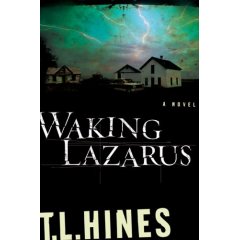
Meet T. L. Hines, author of Waking Lazarus


Meet one of my new favorite authors. There's a lot of buzz going on about him right now, due to his fabulous debut novel. Read below my review AND interview. Thanks, Tony!

It’s an age-old question, one that individuals have asked themselves for eons: Does my life have a purpose? Some know already why they exist on this earth, some don’t. Jude Allman doesn’t have a clue.

Not your normal Nebraskan, Jude Allman has risen from the dead three times. How does one survive drowning, lightning, and freezing after arriving DOA at a hospital? No one. Except Jude. He’s a medical anomaly and small town celebrity. But he’d rather slip away into obscurity than be asked about his journeys to the Other Side.

So he moves away to a secluded little Montana town. For a while it seems he can fade into the background and appear normal to prying eyes. When odious crimes touch close to home, Jude is thrown into the middle of a foreboding mystery. Can he trust the people around him, or must he find his way alone?

This novel appeals to me on many levels. If I can’t finish a book in three days, it’s probably not exciting enough—I easily gulped this one down within that time period. I love spooky—this fits the bill. The mounting expectancy gripped me. My pages nearly singed due to my lightning-fast turning. The supernatural element sent me sky-rocketing into fiction heaven. Bravo to the author for fashioning a tale that has implications far beyond the physical here and now.

As far as predictability, there’s not much. I have to admit, I did figure out one major plot twist before it was revealed, but that’s just my keen observation at work. (Ha.) There were plenty of fragments the reader won’t be able to piece together on his own.

My high recommendation comes with a warning. This isn’t for the faint of heart. If you relish dark, mysterious, stomach-clenching stories, get this book. I’ll leave the light on for you.

~ ~ ~
1. Have you always wanted to be a writer, or did you dream of being a rock star, doctor, or other such thing?
Hey, funny you should ask that. I've always loved, loved, loved music. When I was about 12, I decided I wanted to be Jim Morrison. My only problem? I can't read, write, sing or play music. I didn't let that stop me, so I decided I'd be a deejay. In high school, I thought about trying to become a recording engineer; I remember sending for brochures
and materials from an "audio engineer" school that advertised in "Rolling Stone" magazine.


2. Your road to being published is somewhat of a fairytale. (That can either depress me or give me hope.) Tell what happened in your writing during the years before that fateful day.
Yes, it is kind of an amazing story, isn't it? My book was "discovered" on my blog when an acquisitions editor read the first chapter and asked for more--after I'd had more than 100 rejections. You can't make up this kind of stuff.

The rock star/deejay/recording engineer career path aside, my "serious" desire was to write from a rather early age. About age 12, in fact. Writing was always an escape; I remember spending long nights in the basement, writing notes, journals, stories and the like. During college, I studied English and Advertising, and went into the Advertising field to write copy for 16 years--everything from business plans to restroom posters to television spots to articles to advertorials. And you know what? Every bit of it helped; I'm thankful I've had that career.

In 2003, my wife and I merged our advertising agency with a larger advertising agency, which helped me focus on my first love: writing fiction. Even so, I managed to go through most of my rejections--I said more than 100 before, but it was more like 160--from 2003 to 2005. That was for a couple of different novels. I started getting frustrated, and really came to a standstill on my writing because I felt horrible I wasn't getting published. Then, I had what I consider my Abraham moment: I offered my overwhelming desire to be published as a sacrifice, and told God it didn't matter if I was ever published or not
because I was going to write for the sheer love of it. And two weeks later, I got that email from Dave Long at Bethany House, asking to see my whole book.

Like I said, you can't really make up this kind of story. But God can.


Karri here: That reminds me a whole lot of Bruce Wilkinson’s book The Dream Giver. We are called to lay down the dream God has given us and give it back to Him so, in time, He can give the dream back or give us a new/bigger/better one. ☺

3. What is your favorite/least favorite part of writing?
You know, depending on the day, I can hate or love every part of the process. But I have to say, I'm probably a bit odd in that I actually like the revision process more than the first draft. I think most writers love the "creation" of a story. I do, too, but I think I almost prefer having a good skeleton to work with, and being able to add some muscle to it--that's what all the subsequent drafts are about.

I don't know that I can say there's a least favorite part of writing, really. I do love everything from the brainstorming to the final draft, making new discoveries along the way.


4. Is there anything you've realized related to writing that you wish you had known earlier?
The single biggest breakthrough for me has been: get a first draft in the can. When I was a younger writer, I spent a lot of time writing. Unfortunately, most of that time was spent writing and rewriting the same 50 pages, and never moving forward. I remember thinking I'd never finish a novel. And with that work method, I wouldn't have.

It took me many years to discover the joy of blasting through a first draft, not worrying about holes or perfect sentences or grammatical errors or the fact that I changed the name of my main character from "Eddie" to "Chamberlain" in Chapter 16. When I decided it was okay to just get the story down on paper, I made a huge breakthrough. And you know what? Sometimes, on that first draft, I can get into this great zone and just cruise through 20-30 pages at a stretch, without going
back and making a lot of changes. In WAKING LAZARUS, without giving away too much of the story, there's a section that takes place in Kenneth Sohler's house. It's a very tense, action-packed section, with some of my favorite scenes in the book. And that whole section was written, almost as it appears in final form, in one day. I think letting the story carry me along in the first draft helps get me to some of those nice stretches. It doesn't always happen, but it happens.

It may not happen for everyone, however; what works for me may be wrong for you. I truly think every writer has to discover the method that works best for her.


5. Some authors start with story, some with a character, some with a theme. Which do you start with?
Great question. I don't know that it's always the same with me, but I can tell you, more often than not, it's a character. Every writer, I think, goes through the day asking "What if?" questions. Most of my "What if?" questions are about character: What if there was a man who kept dying and coming back to life? That was the question that led to WAKING LAZARUS. It started with the character of Jude, who and what he was, and developed from there.

6. You mention that Stephen King inspired you. What other authors were pivotal in your journey?
So many, really. When I was young, I read a lot of strict genre fantasy and SF fiction: I absolutely loved Jack L. Chalker, Piers Anthony, and Roger Zelazny. As I got older, I started getting into some more genre blends of literary/SF/horror/modern fable--stuff I think is best called "slipstream" fiction. This included Robert Heinlein, Ray Bradbury, Richard Matheson and the like. They were writers who wrote horror or Sci-Fi or whatever, but also mixed in elements of other genres. Then, in college, I started turning to a lot of crime fiction. A couple of my current crime fiction faves are George Pelecanos and James Lee Burke. Hemingway has been a big influence; I've always loved and studied his dialogue. And in faith-based fiction, of course, I certainly owe a tip of the hat to writers such as Frank Peretti, Ted Dekker and Brandilyn Collins. Without the trails they blazed, I wouldn't be published today.

7. How do you balance your day job with your writing?
Not always so well, I'm afraid. When I'm working on a manuscript, I try to get up at 5:00 am and work for what I consider my "golden hours"--the first two hours of the day. As far as writing goes, that's the best time for me. Then, I'm off to the "day job" at the agency from 8:30 to 5:30; during the workday, I try to answer emails and what-not as I receive them. Evenings after 6:00 are family time; I have a lovely wife and a lovely eight-year-old daughter, and I try not to let my work take up too much of their time. I'd love to devote more time to writing, because honestly, some of those "golden hours" in the morning get occupied by marketing efforts and what-not. But the arrangement is working so far. I can produce a book a year with that schedule.

8. Do you think in the future you'll try to market another book in the ABA?
I don't know. Maybe. I've spent so much time on that ABA/CBA fence that I'm unsure if it's horribly meaningful to me anymore. It seems to me that so many writers in the CBA want to work in the ABA/general market/secular market/whatever you want to call it. At the same time, however, I think there are a lot of ABA writers who would love to break into CBA bookstores--longer sales cycles, less competition, and a growing market ("religious fiction" is one of the few growing categories of fiction). I have friends who have published in the ABA, and I can tell you they're envious of the treatment, attention and support I've received from my CBA publisher. I also recently read an article about George Pelecanos, one of my favorite ABA crime fiction novelists, and the sales figures for his books. This is a guy who has received great reviews and attention for his work, and his hardcover sales are surprisingly anemic. Would I really be better off on ABA shelves as a midlist author, grouped with ten times as many books where it's even more difficult to stand out? Who knows?

I'm overjoyed to be where I am, and I'm happy to be finding an audience.


9. What is the main thing you’re trying to achieve in your writing?
I really believe you have to write for yourself first. I mean, you're telling stories for other people, but the meaning, the heart of the story, has to come from you. It has to mean something to you; if it doesn't grab you personally, it doesn't have a chance of grabbing readers. I think there are books like that on the shelves, and you can figure out you're reading one of them within a few pages. So I really want people to FEEL something when they're reading what I write. I concentrate on the plot/story level, so maybe readers feel excitement or fear for a character in peril. If they do, that's great; I've done my job. I also try to say something with the theme and the subtext, though; I want to explore bigger questions in my work. So if someone reads WAKING LAZARUS and notices the main character is named "All-man", and relates to his journey of discovery, well, that's also great. Either way, I'm happy.

10. Can you tell us about your current writing projects? I eagerly await your second book.
I'm working on my second book for Bethany House right now. The title for the book was just selected yesterday, and it's a title I really love: THE DEAD WHISPER ON. It's about a woman who hears her dead father speaking to her from the shadows. He tells her the shadows of our world are occupied by dead spirits, and recruits her into a secret government network that works with the shadow operatives. But of course, she soon discovers all is not as it seems.

The book takes place in Butte, Montana, a city I really love. And, it's a little bit "out there" in terms of some of the things I'm trying to do. WAKING LAZARUS made me nervous because of the brutal content; THE DEAD WHISPER ON makes me a bit nervous because of the supernatural factors. But it's been a lot of fun to write, and its messages mean a lot to me personally. I think of it as a cross between crime noir fiction and "The X-Files."


(Karri here: that sounds fabulous! Hope I'm one of the first to read it!)

I'm also starting to develop some proposals for other works: a three-book series, and three more stand alone books.

11. What is your best advice to writers out there?
This is going to sound aloof, but the best advice is: write. Just write. Don't worry about publication so much. Don't worry about what others think of your work so much. Just write something that moves you personally, that means something to you. In Christian terms, I think writing can be very akin to prayer on so many levels, and if you're being honest and exploring issues that mean something to you, your writing will bring you closer to God. Even if you don't want to think of it in Christian terms, self-examination is a powerful thing.

Ironically, though, if you do that, I think you'll be writing the kind of vital work publishers are wanting. If you're a person constantly worried about the "marketability" of your writing, or if you're thinking, "Maybe I should try chick lit because it's selling well," or if you're constantly haunting online web sites and asking questions about formatting or structure or whatever, I would suggest you're not working on something that's meaningful enough. Write about what haunts you and occupies your mind. Write about what takes your breath away. Write about what scares you.


Karri here: Eep. Um, what an idea. *gulps*

12. You've certainly heard from many readers. What do you think readers want? Why will they pick up a book and stick with it?
It's so, so wonderful to get an email from someone who has read the book and enjoyed it. Really. Just one of those emails keeps me smiling all day, and it never gets old. We humans are social creatures, after all, and we crave feedback from others. Writers are probably even more twisted: we work in isolation for so long, and want people to read and
like what we've written. It's something like being on a deserted island and getting a message in a bottle.

This may sound odd, but I think readers want to feel as if they're not reading. By that I mean, they want to pick up a book and visit another world, and forget they're looking at words on a page. That's the magic of writing--and reading. I've talked to a few people who have said they'll usually finish a book after they've started it, even if they don't like it very much. They want to know what happens. That's not the case with me. I'll read a book, and give it maybe 50 pages to transport me. Or, I'll give it three or four "flubs." A "flub" is something that jars me out of the story--an awkward phrase or a character who does
something that seems utterly illogical. If I hit page 50 or too many flubs, I move on. There are plenty of books out there I'll enjoy; why waste time on ones I don't? I don't want reading to be work. I want it to be magical.


13. Is there anything you'd like to say to your readers?
I think it's impossible to say "thank you" too much, so: thank you to everyone who picks up something I write. If you love it, great. I'd love to hear from you. If you don't love it, well, I certainly appreciate you giving it a shot. And you know what? I'd still love to hear from you. I may be a bit too starved for attention, in fact; I've created a special section of my web site called the Other Side (http://www.tlhines.com/otherside.html), where people can sign up as volunteer publicists for the book. In exchange for telling others about WAKING LAZARUS, people get inside information and deleted scenes from
the book, and a chance to win unique prizes: an iPod Nano, a share of my first royalty check, or a role in the next novel. See? I told you I was starved for attention.


*Karri erupts into song: ”Break on through to the other side…”
Thanks again, Tony, for taking time out of your busy schedule so we can get to know you. Here’s the website again, folks: http://www.tlhines.com/. Go pay him a visit.

Friday, July 28, 2006

Presenting...Interview with Melanie Wells


Please see the archives for reviews of both books.


I have a penchant for suspense, especially the supernatural. So naturally my reading would take me to Melanie Wells' work. Not only is she a fantastic writer, she's insightful and humorous, too. She will also return your e-mails, which is an added plus. :) I just had to interview her, so here it is...(I didn't even have to mow her lawn in return. What a peach.)

1. What is your writing story? How did you start your journey as a novelist?
Like all writers, I started out as a reader. I can remember sitting up by myself at 2 a.m. reading my Dr. Seuss books when I was 4 years old (like most writers, I am also an insomniac). I also had the entire collection of Grimm’s and Anderson’s fairy tales, which I read obsessively. This could be, by the way, why I write such dark stories. Those fairy tales are some tough mojo – people are always getting cursed or transformed into swans or left to die alone in the woods. I tried writing stories when I was a kid, but they were terrible and depressing, since all my characters were orphans (fairy tale influence). I didn’t make a serious attempt at writing until about ten years ago. I was living in Steamboat Springs, CO, and it snowed 15 FEET in one month. There was nothing else to do, so I started writing a novel. And that was the beginning of the end.

2. You have two books out now, published by Multnomah - When the Day of Evil Comes, and its sequel, The Soul Hunter. I've seen others compare your "spiritual warfare" elements to that of Peretti and Alcorn. Would you say their statements are accurate? Why or why not?
I would say the comparisons are accurate only in a very general sense. My books are very different in tone from theirs – I make a point to keep mine quirky and funny, whereas their books feel more serious and dramatic to me. And I think our theology of angels and demons differs as well. I wouldn’t mind our book sales being comparable, though! If as many people like my books as like theirs, I’ll be in the Caribbean by now.

3. Tell us a bit about the idea behind your Day of Evil series.
The idea behind the series came from a dream I had at my best friend Trish Murphy’s house. She’s a singer/songwriter in Austin, TX. I was there for a writer’s week – we write all day and then fry chicken or make tuna casserole at night – and had a dream about a creepy white guy with a slash on his back. There was a ring and a necklace also and the whole thing was set at Barton Springs in Austin. I wrote the first chapter of When the Day of Evil Comes the next day and we spent the rest of the afternoon at Barton Springs talking about the creepy demon dude. We named him Peter Terry after two ex-boyfriends we don’t like (if you date a writer, you’ll pay the price if you ain’t nice).

4. In what direction do you think the CBA should be going in regards to the fiction it publishes? What is your hope?
I’m not sure how to comment on this because I’m not a huge fan of the concept of “Christian” fiction in the first place. I don’t like to use Christian as an adjective. I think it’s off-putting. I’d like the CBA to produce challenging, literate, interesting fiction, just like the rest of the world should aspire to do. Why should we be any different?

5. What is the hardest part of writing for you?
The solitude. Hate it.

6. Is there any ritual you go through before you sit down to write?
Other than re-folding my socks, sorting my coins into piles by date and type and generating lame reasons to send e-mails and generally avoiding writing entirely? Um, no.

7. You have a great sense of humor. Do you want people who have read your books to come away laughing, thinking, constantly looking behind them, or all three? (I ask because I did all three.)
If you’re not doing all three, I’ve blown a tire and need to change something. Definitely all three. In equal measure.

8. I noticed that in the picture of you on your website, a coffee mug sat closeby. Is coffee your secret vice?
I’m a tea person. Besides, if it were a secret, I couldn’t possibly tell you, could I?

9. When will your third book be released? Give us a teaser.
The third book, which I’ve tentatively titled Suffer the Little Children, is due out in October of ’07. It will feature the little girl, Christine Zocci, from the first two books, and also the little boy Nicholas Chavez from The Soul Hunter. Dylan will be back, of course, as will Peter Terry. And I think I’ve actually figured out how to tie up all the loose ends (the wedding ring, the necklace, Peter Terry’s identity – the whole banana), which will be a relief to everyone, especially me.

10. What is your best advice for yet-to-be-published authors?
I made myself a promise when I started writing that I would let anyone who asked read my stuff. And for years, I did that. I learned more about writing from those first terrible drafts (and all the depressing feedback I got) than from anything else I could have done. Let people read your work, then toughen your spine, thicken your skin, and listen to what they have to say about it.

11. Is there anything else you'd like to tell the readers?
Little known (but illuminating) facts about me:
I love office supplies. If someone at the office walks off with one of my pens, we have a kangaroo court and a public hanging in the parking lot.
For some reason, I never have stamps.
When I was little, I wanted to be a product demonstrator when I grew up (demonstrating shampoo, makeup… whatever – as though this is a real job).
My dog, Gunner, weighs 5.7 pounds and is two tons of trouble.
The first concert I ever attended was K.C. and the Sunshine Band (lame).


Thanks so much, Melanie. That's more information than we wanted to know *grins*. I've listed the links for your sites below. Everybody, go check her out!
www.melaniewells.com
www.peterterry.com

Friday, July 21, 2006

For You are my hiding place...Psalm 32:7a

"The truth, Sir, is that God's viewpoint is sometimes different from ours - so different that we could not even guess at it unless He had given us a Book which tells us such things." - Corrie ten Boom to a German lietenant while in prison

"I pity the poor Germans, Corrie. They have touched the apple of God's eye." - Casper ten Boom, watching German soldiers taking Jews and sympathizers away

"If I go home today, tomorrow I will open my door again to any man in need who knocks." - Casper ten Boom, when told by a Gestapo chief he would be freed if he would not cause any more trouble (Casper's arrest eventually led to his death)

"Thank you for the very crowding here. Since we're packed so close, that many more will hear!" - Betsie ten Boom praying with Corrie in their barracks at the Ravensbruck concentration camp, flea and lice-bitten and near starvation

These quotes come from The Hiding Place, the well-known true story of a Dutch family providing underground assistance to Jews during World War II. These brave Christians acted on their belief that all life was precious, and that giving one's life for another was a privilege.

We are so blessed in America. Over-blessed, I think. We have too many distractions that keep us from getting to know God - to sit quietly in His presence and learn from Him. I often wonder how I would respond in tragic times. Hopefully, I would act in faith, as the ten Booms did. They had next to nothing materially, but they had all they needed in Christ. May God not have us become destitute in a war-ridden country in order for us to become totally dependent on Him.

Thursday, July 20, 2006

A New Project


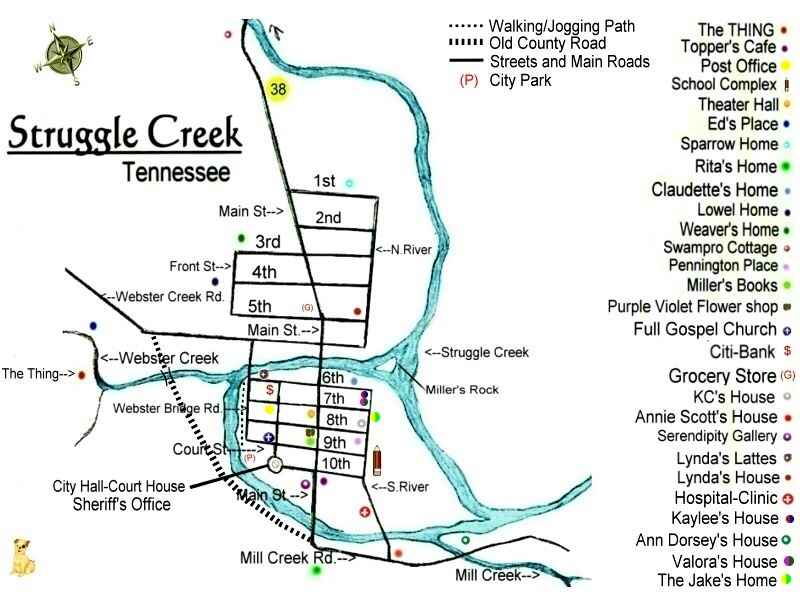
Here's a rendering of the fictional town, Struggle Creek, Tennessee, the setting for a new team novel.

Almost two years ago, this newbie writer joined an organization called Faithwriters. It's a place on the web to showcase/share your work, make writer friends, be challenged, better your craft, and perhaps gain notice in the publishing world.

Right now I'm working with some friends from Faithwriters called Peculiar People on a collaborative novel of sorts. It's a unique idea - one plot, twenty-four authors. It's kind of a small town mystery with a production for the deaf thrown into the mix. A very novel idea, if I do say so myself (pun intended).

I can't wait to see how it turns out. There are some very talented writers in this group ( I do not include myself), and it should end up a quality piece of work. Stay tuned for updates.

Friday, July 14, 2006

Presenting: Kathryn Mackel interview and review of The Hidden


540377: The HiddenThe Hidden

By Kathryn Mackel / Thomas Nelson

Boston psychiatrist Susan Stone receives a phone call from her stepmother in Colorado. Her father Charlie has broken his leg and needs her to assist with his horse farm. Still reeling from her husband’s recent death and son’s suicide, Susan reticently returns for a short time. Having left Colorado behind, along with acidic family memories, Susan struggles with the change of venue. Will she be able to face her past and strangle the demons that threaten to consume her?

Charlie, relegated to a wheelchair, asks Susan to deliver the foal when his prized Arabian is due to give birth and the veterinarian doesn’t show up. She does the best she can, but as a result of her imperfect method, both horses near death, needing further medical treatment. After receiving a verbal barrage from the stable girl, Melissa, Susan jumps on another horse and rides into the hills, seeking refuge from her mistake. She half hopes never to return, but instead of ending it all, she is thrown off her horse near a dark cave. What she finds there will change her world forever.

A young man without a name is bound in chains. He has no memory of who he is or how long he has been there. Can Susan help him, and in doing so relieve the guilt of failing to help her own son? She uses psychiatric techniques to draw out the stranger’s memory, but the answers make her even more confused. And who needs therapy more, him or her?

Another mystery surrounds the ranch: the discovery of charred remains. No one knows what on earth could cause such horrific effects. As sheriff Rick uncovers more clues, he suspects that the murders have something to do with the stranger. But what? Who is the man, really, and how is he connected to the murderous burnings?

One important background character provides supportiveness and kindly wisdom throughout the story– Jeanette, Susan’s stepmom. Her rocklike stability makes the others question their faith or lack of it. It’s interesting to see how Melissa, Rick, Charlie, and the stranger react to her.

This tale ultimately revolves around the unseen. Evil lurks around us, and most of the time, we can’t see it with the naked eye. But it is still in a battle with good. Which will we choose to ally forces with? Are we ready to encounter the evil within ourselves, as well as without?

I recommend The Hidden on the grounds of its high suspense, spookiness, and positive thematic elements. The author approached many topics including depression, suicide, suffering and forgiveness in a thought-provoking manner, leaving me fodder to mull over well after the last page was turned.


Now for the author interview (thanks, Kathryn!):

1. Where did you get the idea for The Hidden?

It’s hard to answer this without giving away the twist of the story. So I’m going to be a bit vague and say that, after reading a couple of seldom-discussed verses in two of the epistles, I got the concept for the plot. What was always important to me was not trying to explain these scriptures—because I can’t—but to use them to explore forgiveness.

From the moment I first conceived of the story, it had to be in Colorado and had to involve horses. I mention that because I’m from New England and don’t ride. It’s a curious thing about stories—sometimes they seem to take their own life, beyond the author’s control.


2. This is a supernatural tale, yet you hold the main theme as
forgiveness. What do you hope the reader takes away from the story?


In The Hidden, Susan Stone is abused by a mentally-ill mother and neglected by a father who can’t cope. She leaves home, choosing to be estranged from her family for thirty years. Rather than acknowledging her pain and injury—which is significant—she compensates by becoming the ‘perfect’ mother. The irony is that she was a good mother and, as a widow, single-handedly raised a gracious son. Yet when faced with his decision to do something she was against, she rejected him in the same way that her own mother had been rejected.

I believe the hardest people to forgive are our parents. Because of that, it can be very hard to trust a loving Father. Even a believer walking in faith may not admit that but allow bitterness to fester deep down, where he or she doesn’t have to deal with it.

When we’re gravely injured psychological, emotionally, and spiritually—like Susan Stone—we simply can’t get out of our own way. That pain is real, and our Lord knows that. When we pretend otherwise, or running cursing in the other direction, bitterness grows and grows until it becomes toxic. Redemption is not about changing the past but about changing us—giving us a new life, a new hope, and the power to forgive.

If even one reader comes away seeking forgiveness—and the divinely-given power to forgive—than I’ll have done my job.


3. What is your favorite and least favorite thing about writing?

My favorite thing is when I hit my stride. That means I know my characters, have found the voice for the novel, and I know where I’m going. What I love about this is that this is where craft leaves off and inspiration takes over. (Not that craft isn’t always important.) This is the time and place where the Holy Spirit can supply the vision—where I can find Christ in my writing. For example, the scene in Outriders when Brady kneels to give the giant Jasper a clear shot at his neck was not something I planned. But, beyond my rational-writer control, for a moment I knew that Jesus would do this if he were in this situation. And so Brady did. When I experience writing a moment like that, I am blessed beyond words. And I pray my readers are blessed when they read those moments.

My least favorite thing is writing synopses. My fiction students would be delighted to know I have been through this agonizing process recently in preparing a proposal for a series I’m writing. It’s a whole lot easier to critique them than to write them. This proposal was tough because I had to summarize the series as a whole, plus three books (with only one written), plus where the series could go from book four on. Then I had to write a full synopsis for book one. A good exercise for someone who teaches fiction, but painful!


4. Is it difficult to write across genres? Explain.

I have bounced around, haven’t I? I’ve done blockbuster Sci-Fi, family, and suspense screenplays for Hollywood. Supernatural thrillers and fantasy for adults. Sports and Sci-Fi for kids. A writer doesn’t ‘choose’ genre so much as write in areas he or she has aptitude and inspiration. If someone asked me to do romance or chick lit, I’d fall apart.

What is very difficult is working on different projects at once. Right now I’m working on a kids’ sports book, a screenplay, and a thriller novel. Sometimes I feel like my mind is stretched like a rubber band, then snapped.


5. What can we expect from you in the future?

I’m writing the screenplay for The Hidden for Namesake Entertainment. I’ve worked with them before (Can of Worms, Hangman’s Curse). They’re about to bring out Ted Dekker’s THR3E and are making Peretti/Dekker’s HOUSE right now. Trackers comes out in October. That’s the sequel to Outriders (The Birthright Project). And I’ve got a couple of projects out in proposal form.
.
6. Is there anything else you'd like to say to the readers out there?

Thank you for supporting Christian fiction. From the bottom of my heart, thank you.

To those of you who are writers, don’t give up. Work on your craft. Be fierce with your weaknesses and just as fierce developing your strengths. I just read the acknowledgements for Colleen Coble’s latest (out this fall) FIRE DANCER. She speaks about those “long first seven years when no one wanted to buy anything”. Now she is a premier writer of romantic suspense.

Writing is often such a lonely, thankless job. Hold to your vision, work on your craft, and when you face rejection, keep going.

Sunday, July 09, 2006

And the Winner is...

LINDA WATSON OWEN!!!

Stay tuned to see if she is the lucky grand prize winner.

Thank you to everyone who entered the contest. I enjoyed each and every one of your entries. Hopefully, I'll be able to run another contest very soon.

Friday, July 07, 2006

The Redemption review and pirate poem contest!


93593: The RedemptionThe Redemption

By M.L. Tyndall / Barbour Publishing

Welcome! After you've read my review and the Q & A with MaryLu Tyndall, please enter my contest! Post a pirate-y poem less than 100 words in the comment section for a chance to win a free copy of The Redemption! The winner will be placed in the drawing for the grand prize: two tickets to see Dead Man's Chest!

Fans of romance, historicals, or Caribbean pirate lore will love this tale. Set to release soon after the movie Dead Man’s Chest, it contains familiar pirate-y elements such as sword fighting, shipwrecks, hangings, cannons and swarthy sea-faring men. Not to mention a fair lady in distress who is taken captive by the most handsome pirate she’s ever seen. Weave in faith, hope, perseverance, and yes, redemption, and you’ve got an action-packed yet heart-warming story.

Charlisse Bristol runs away from an abusive uncle in search of a father she’s not sure is even alive. She will brave any obstacle to feel his loving arms around her just once. But when the merchant vessel that carries her is destroyed in a storm, she finds herself shipwrecked on a small island alone for weeks.

Just when she has lost hope of rescue, a band of pirates arrives and makes camp on shore. She sees no alternative but to sneak in unnoticed in hopes of satiating her empty stomach. Her plan foiled, she is captured and brought to the captain of the ship, Edmund Merrick. But all is not as it seems. Merrick may be rough around the edges, but his honor won’t allow Charlisse any harm. In fact, he resolves to protect her until she can find her father.

Can Charlisse see past Merrick’s seemingly horrid occupation to the heart? Will she be able to put the past behind her and accept what her search yields? Where will she ultimately find love in the sea of deceit that surrounds her?

My hat goes off to MaryLu Tyndall for causing me to enjoy a romance novel. I can’t remember the last time I’ve read one, as I prefer supernatural and high suspense thrillers. But my fascination with the Pirates of the Caribbean proved to heighten my enjoyment of this novel. It is well-written, interesting, and carries a fresh twist to the conventional pirate story.

(Q&A with MaryLu Tyndall:)

1.) Tell us a bit about the story.

My story begins with a horrific storm at sea in which Lady Charlisse Bristol becomes shipwrecked on an island. She has run away from an abusive uncle in London and sailed to the Caribbean in search of a father she has never known. After weeks of combating the elements, her salvation comes in the form of a band of pirates and their fiercely handsome leader, Edmund Merrick.

Captain Merrick has only recently given his life to God and turned his back on a life of piracy to become a privateer. While battling his attraction to this winsome lady and learning to walk a more godly path, he offers to help Charlisse on her quest-until he discovers her father is none other than Edward the Terror, the cruellest pirate on the Caribbean. Edmund must find a way to win this lady's love while shielding her from his lecherous crew and working to bring her father to justice.


2.) What sparked the idea to write about pirates?

I've always had an obsession for pirates-those swashbuckling heroes who roamed the wild Caribbean seas in their tall ships. The Golden Age of Piracy was such an adventurous and romantic time in our history, and having grown up in that part of the world-south Florida-it grabbed my interest at an early age. What sparked the idea for the novel, however, was the Disney movie, Pirates of the Caribbean. After I saw it several times with my daughter, I had a desire to write about pirates that wouldn't go away. Why do the evil pirates get to have all the fun? Why not write about a Christian pirate?

3.) As you researched this subject, what most surprised you?

The biggest surprise for me was discovering that not all pirates were vicious thieves and murderers. Many, in fact, were commissioned by their countries during times of war to disturb merchant shipping lines and fleet movements, and in general to play havoc with their enemies. In fact, one of the most notorious pirate captains, Henry Morgan, commanded his own fleet of pirate ships, called the Brethren of the Coast, whose sole purpose was to raid Spanish ships and towns in the Caribbean. He was eventually knighted by King Charles II of England and became the governor of Jamaica. These facts aided my story a great deal as many of these pirates, who turned privateers, had strong religious convictions.

4.) How long did it take to write your first novel?

I began writing The Redemption in the Fall of 2003, but it was slow going at first. I was working full time as a software engineer, not to mention my responsibilities at home as wife and mother. I'm sure many of you can relate. There just doesn't seem to be enough hours in the day! Consequently, I did not complete the novel until early Spring 2005, yet I still didn't feel it was ready. I hadn't written in a while and needed some counsel, so I hired two editors to go through my manuscript, and I entered four contests for the feedback. I made the final cut in two of those contests and felt encouraged, but I must admit, I learned a great deal more from my editors. By the end of Spring 2005, I had polished the manuscript the best I could and went looking for an agent. God's timing is always perfect. I was laid off from my job of fifteen years the same month my agent took me on as a client and began submitting The Redemption. By September of that same year, I had a contract in hand from Barbour for the entire three book series!

5.) How long must we wait for the sequel?

Not long! The second book in the series, The Reliance, will be released in January 2007, and the third book, The Restitution, will be out in stores, June, 2007. As you can tell, I've been very busy!

Tuesday, June 13, 2006

How Far Have You Come?

The writing life demands much from a person. You authors know what I mean. Solitude gets old, the blank page screams a bit too loudly, and if you’re lucky, a deadline looms over your head. You then bang your head on the desk. Again.

Recent circumstances have caused me to doubt the writing journey. I don’t know what I’m supposed to be doing. My nerves are wracked, my brain is dead, and my fingers haven’t seen much action at the keyboard. What’s wrong? I’ve forgotten to remember.

My parents visited my family a few weeks ago, and while at the beach, my mom and I took a long walk. The ocean looked like it went on forever, as did the sandy shoreline. Finally, we decided to turn around and go back. As soon as I looked behind me I said, “Wow, I didn’t realize we had come so far.” That was an epiphany for me.

It’s no surprise that God told the children of Israel repeatedly to “remember”. He didn’t want them to forget all He had done for them, all of His promises and commands. We, like the Israelites, are sheep who often forget where we are or how long it has taken to get there.

Less than two years ago, I embarked on the writing path. I’ve been paid for a newspaper article and a book review. My bookshelf holds two anthologies with my work in them, as well as a Christian newspaper that includes my article. I review for several websites and I receive free books from them and a PR firm to review. Recently, I interviewed an author on my blog and reviewed her book. Tucked away in my files is a completed and edited 5,000-word short story dying for a market.

Whoa. When I take time to remember, I see how far I’ve come. Yes, God is the reason I accomplish anything. He has allowed me a measure of success and fulfillment. I’ve gone from nothing to something. No, I haven’t started my novel yet, but I’m having a blast trying. Sort of.

Are you in the same boat, oars flailing and thinking you’re getting nowhere fast? Remember what God has done for you so far. I’ll bet it’s more than you think. Give your concerns to Him and He will take care of them all.

Saturday, June 03, 2006

Susan May Warren, author of Everything's Coming Up Josey - review and interview


Meet Josey Berglund, a small town journalist who fancies herself a Lara Croft/Mother Teresa blend. She wants to somehow make it big at a New York newspaper as well as change the spiritual landscape of the world. If only she can get through her sister Jasmine’s wedding to her former boyfriend Milton without throwing up.

Chase arrives at the scene, giving the day a bit of hope. Her best friend since elementary school, Chase reminds Josey she deserves better than Milton. The pick-me-up lasts only so long, though. Up walks a buff model type, who is promptly introduced as Chase’s fiancé. What will Josey do now? She and Chase are the last two singles in Gull Lake, maybe the whole world, and now he’s taken. Not that she could’ve married him anyway. He doesn’t know Christ (yet) and he’s too cousinly, though the braces and acne are gone and his blue eyes still sparkle like the ocean on a sunny day.

Life goes on. When Josey hears a missionary from Russia speak at her church, she knows that’s where her life is headed. For a whole year. She’s got nothing to lose and parkas, hiking boots, converted souls and strange food to gain. Oh, boy. And maybe she can also figure out her love life while she’s overseas.

Woven within the hilarity of missionary life is the all-important lesson for Josey: God uses imperfect people to do His work. All he needs is a willing heart that wants to make a difference. We, too, can tuck that one away.

I will never again look at chick-lit in the same light. I’m a suspense/thriller gal at heart, but a good laugh goes a long way on this crazy-busy planet. This book delivered on so many levels – it's a must read. In fact, a friend of mine is going on a cruise next week, and when she asked to borrow a book from me to read, this was the first thing I mentioned (she had better bring it back suntan oil free). Thank you, Susan, for taking us on such an honest and hope-filled journey.

~~~

Susan May Warren has been writing since she was a child. She pursued journalism in college, but ended up a missionary. Having spent six years in Russia, Susan used her gift for writing by crafting newsletters, then progressed to articles, short stories, novellas and full-length fiction. She and her family now make their home in Minnesota.

Me: You wear lots of hats: wife, mom, missionary, writer. What is the secret to balance in your life?

SMW: Okay, see, that's really nice of you to think that I might REMOTELY have any balance to my life. I think it depends on who you talk to in my family and on what day. But I give it the big college effort to start my day with my Quiet Time and somehow things smooth out after that. And I try to a) not take life so very seriously. The house WILL get cleaned. Right after the kids leave for college. b) remind myself that food groups don't have to be eaten in one sitting; for example, you can have cheese and dairy one day, bread (ie, pizza) the next, and if you're REALLY feeling good, a Caesar salad the next. If you think of it in WEEKLY food needs, I think it's a lot less stressful. c) keep it simple with the kids. Climbing into bed with each of them at least once a week and letting them tell me a bedtime story is usually pretty good quality time. (Although my husband isn't thrilled with the part where he has to wake me and drag me to bed.) I take that bad. I'm balanced.

Me: Tell us how your experience as a missionary in Russia inspired you to write this novel.

SMW: Revenge? Oh, no, you want something spiritual. I know God had taught me lessons that I could share with other hopeful missionaries, or maybe just regular women like me who wondered if God could use them. And well, I had all this good material -- I didn't want it to go to waste! I mean, after you sit on a rat in your toilet, you HAVE to tell somebody, don't you?

Me: What do you most want the reader to take away from your story?

SMW: That you don't have to be perfect to be a missionary. In fact, it's better if you're not because then God can do all these great things in your life, and when you DO say or do the right thing, you'll know it wasn't you. And that's pretty cool.

Me: Did you craft any of your Russian or missionary characters from people you actually knew?

SMW: Wait, if I answer that, am I going to get sued? Okay, so Totyemilla MIGHT have been SORTA like my neighbor who brought me liver peroshke. And Larissa, well, wade into a Russian mall and pick a girl...they're all skinny, all beautiful, and all dressed like they were Paris Hilton. Yes, me and my hiking boots wanted to crawl into a corner and wail. As far as the other missionaries, let's just say there is no shortage of Susie Homemakers on the mission field (and there is nothing wrong with a Susie Homemaker -- you're talking to a girl who grew her own strawberries and made her own jam, it's just that it's not the ONLY thing attribute to being a good wife and mother) so I didn't have any one person in mind. Really. I suppose everyone is a morph of a few people scrunched together. But I'm not telling who.

Me: Tell us your favorite part of this book if you can do so without giving anything away.

SMW: Hmm...the fish story, which is a REAL story. I still laugh when I read it. And maybe the Christmas scene with the little golden rings. But mostly, every scene with Chase. I am deeply, hopelessly in love with Chase *very big sigh*.

Me: What was the hardest part of writing this?

SMW: Well, I wanted to tell the truth and poke fun at some of the misconceptions about missionaries. But being a missionary is an important thing. It takes courage and commitment and willingness to completely surrender. So, while I did some teasing, I was really poking fun at myself and not necessarily the missionary community at large, which I deeply respect. In fact, I hope to be a missionary again someday, if God opens that door. So I'm hoping fellow missionaries will enjoy the humor, and know that, if we really take a step back and not take ourselves so seriously, it is funny. And human. And in the end, God working through us to remind us that He is at work in us to the praise of His glorious grace.

Me: Thanks again, Susan. You're a super writer. I'm just kinda scared now, because I thought my reading pile was big enough already. Now I'm going to have to add a whole new genre to it!

SMW: LOL!!! I'll be sure to put you on the list for Josey 2! *g* Thank you again for letting me be a part of your webworld!

Tuesday, May 30, 2006

Full Tilt, by Creston Mapes


52506X: Full Tilt, Rock Star Chronicles Series #2Full Tilt, Rock Star Chronicles Series #2

By Creston Mapes / Multnomah Publishers Inc.

We’ve all followed the careers of our favorite bands or musicians. But unless we’ve lived the life of one, we have no idea what one really goes through on a day-to-day basis. Creston Mapes gives us a glimpse into what this kind of life may look like. More specifically, one that has been captured from hell’s flames and is now committed to saving others from destruction.

Everett Lester has had a difficult life. He endured a dysfunctional family before his rise to fame as a rock star in the band DeathStroke. Power and pleasure brought him nothing but dissatisfaction and pain. Until he met Christ, his Savior, and Karen, the love of his life. Things should be perfect now, right? Wrong.

While planning his Living Water concert tour, circumstances hurl problems at Everett that he can’t control. His bails out his brother, Eddie, from his gambling debts only to find he can’t quit betting. His nephew, Wesley, hangs out with meth junkies who snare him into deeper trouble. Everett and Karen must endure a personal struggle of their own as well. Those things, however, may be the least of his worries.

As the evil surrounding Everett grows thicker, he realizes that his family is being targeted by organized crime. Their very lives are threatened as a result of extending a helping hand. Can Everett overcome the external forces pushing and pulling him and also conquer his inward struggle with insecurity and temptation? Will he trust God to work miracles through prayer and obedience?

I highly recommend Full Tilt. It’s easy style and gut-twisting realism kept me enthralled throughout the book. And I, along with Everett and Karen, was inspired to believe God’s promise: “When you pass through the waters, I will be with you; and when you pass through the rivers, they will not sweep over you. When you walk through the fire, you will not be burned; the flames will not set you ablaze. For I am the Lord, your God, the Holy One of Israel, your Savior” (Isaiah 43:2-3a).

Wednesday, May 24, 2006

The Soul Hunter, by Melanie Wells


Creepy. Haunting. Realistic. Thought-provoking. Hilarious. Those are the first words that come to my mind in attempting to describe The Soul Hunter. Oh, and rats. If you can’t handle rats, don’t even pick up this book. Better yet, deal with your rat phobia and pick up the book anyway.

The night before her 35th birthday, Dylan Foster and her boyfriend David are scheduled to go out for a nice dinner. While she is getting ready for her date, Dylan hears a thud at the front door. She runs to open it, hoping for a present from UPS. Instead, she finds a bloody axe on her porch. After reporting the incident, she finds out there has been a murder, and she has been thrown right in the middle of it.

Happy birthday to Dylan.

You’d think Dylan would’ve had enough trouble from demons and murderers. But the saga continues and even worsens for this Texas psychologist. In addition to the axe, terror strikes when Peter Terry shows up again. Can things possibly get worse? Oh yeah.

The story continues as the search for the murderer intensifies. But things are not as they seem. A deeper power is at work for those whose lives hang in the balance. Will Dylan lean on the One who can get her through this ordeal? Will more innocent people have to suffer, or will mercy reign?

In the first book of this series, Dylan learned the inestimable value of prayer and the Word. With that knowledge under her belt, will she put on God’s full armor as the only way to combat the devil’s evil schemes?

There is a battle raging for men’s souls. Those who wish to harm mortal man play for keeps. Thankfully, there is Someone stronger than the forces of darkness, and He is available to those who call on Him. Spiritual warfare is real, as the author has intimated in this supernatural tale. I admire the way Wells has us peer into the unseen (and sometimes seen) and think about what is happening beyond our limited vision. If we have the spiritual eyes to see, we will find God is definitely at work.

I thoroughly enjoyed this novel and highly recommend this up and coming author of supernatural suspense. This genre deserves more fantastic books like this one.

Friday, May 05, 2006

Blind Dates Can be Murder


Readers, be aware. Not only is this book entertaining and inspirational, but informative as well. (How do you get wine stains off a blouse?) Move over, Martha Stewart. Here comes Jo Tulip.

Household hint guru Jo Tulip continues her climb to fame in this second smart chick mystery. Her agent is sure that she will enjoy greater success with her syndicated column and increase traffic on her blog by joining a dating service. Jo proceeds hesitantly, since she doesn’t want anyone to think she’s desperate. Little does she know that will be the least of her headaches.

Jo can solve virtually any tough stain problem, but when her blind date collapses on the restaurant’s floor, she has no remedy for death. The evening deteriorates further as Jo learns that her mystery man was not her real date, but a fake. Instead, she finds her true date tied up in the dead man’s trunk. Thankfully, he is relatively unharmed and good-looking to boot. Perhaps the night wasn’t a total loss. But why was he targeted for violence and she for deception?

Jo phones her best friend, Danny, to fill him in on the news. He expresses fear for her safety amidst the current dilemma, wishing she would be more careful. After all, he is in love with Jo, and must find a way to tell her. Will she respond favorably to his declaration of love?

Danger lurks at every corner. Innocent people teeter at the brink of destruction and criminals keep getting away with murder. How will neat freak Jo and photographer Danny get to this puzzle’s core?

There’s nothing like a good mystery, and this novel is worth its weight in clues. Clark’s characters are delightful, the story full of interesting side plots and an overarching theme of God’s care for us. The heroine isn’t the only one who realizes the hope she has in Christ, and who is able to bask in His forgiveness.

My nod of approval accompanies this lively mystery. I came away encouraged that “regular” people like me can be used by God to change things for the good. Thank God He guides us in the right direction and rewards those who sacrifice their desires for His own. Besides, He alone knows what’s best for us. Who are we to mess with it?

Friday, April 28, 2006

If Only

Today I heard a woman speaker on the radio talking about the "if onlys" in life. Perhaps you are one of those who finds herself bemoaning the fact that a certain circumstance has happened that shouldn't have, or you have something you wish you didn't have. Are you guilty of saying things like: "If only my child wasn't _______ (fill in the blank)..." or "If only _______ hadn't happened when I was young" or "If only I could have _______ , then I'd be happy."

We are fooling ourselves, dear sisters (and brothers, too!), if we believe these lies. God is the Sovereign and loving Lord of all. He means to use everything for His glory and purpose.

How does this relate to writing? I've caught myself in the past thinking falsities such as: "If only I could finish this story or novel" or "if only I could get published". My friends, this kind of thinking will not get us anywhere but into a deep pit of despair. Instead, I give all I have and don't have to God to use in order to make me what He wants. The results are left to Him.

What a freeing possibility!

Monday, April 24, 2006

A glance at my new WIP...

Merritt Holden, forensic psychologist for Delaney County Sheriff’s Dept., has seen his share of tragedy. Years of interviewing child abuse victims cause him to rail at God for allowing such injustice. When the next crime is committed against his niece, all hell breaks loose. His sister, though distraught, is able to help him find the perpetrator through a unique God-given ability. Her best friend Arianne also joins in. Will Merritt find the peace he is looking for before a dangerous criminal targets him?

----

This will be a full-length Christian suspense novel, eventually. Let me know what you think.

Thursday, March 23, 2006

Director's Cut, by Alton Gansky


Maddy Glenn does the mayor’s office proud. She is about to run for congress as well. However, she frequently finds herself in the midst of murder investigations.

When her cousin and budding Hollywood actress, Catherine Anderson, visits while starring at a local theater, trouble finds them both. As Catherine shows Maddy her extravagant new home, they discover something amiss. A dead body is floating in the swimming pool−the body of Catherine’s chauffeur. Is Catherine a suspect?

Then, to make matters worse, a new version of a movie script is delivered to Catherine with extra pages added in that chill her to the bone. They mirror a private conversation that no one should’ve heard and insinuate that there will be another murder.

Maddy’s protective instincts come to the forefront as she tries to find out who is terrorizing young Catherine, while dealing with another serious city problem. Will Maddy be able to solve both dilemmas before time runs out?

This third book in The Madison Glenn series is as delightful and intriguing as the first two. There’s nothing like a murder mystery to keep me turning pages. Maddy is a wonderfully flawed character who is finding her way in her spiritual walk, learning to share her faith, and sort through her own issues. I’m a little biased, since Gansky is one of my favorite authors, but I highly recommend this novel for it’s themes and entertainment value.

Sunday, March 12, 2006

When the Day of Evil Comes


Nightmares. Flies. Rotten egg smell. Suicide. Spiritual warfare. Whoa. And that’s just the beginning.

It is summer in Dallas and Dylan Foster, a university psychologist, likes her life. Until she meets a strange man at a faculty picnic. Who is he and what does he want?

Matters worsen when she and all her coworkers receive anonymous gifts, a former student says she harassed him, and the engagement ring that should be on her dead mother’s finger shows up once again. A friend of hers insists she has called and asked him out. What in Texas is going on?

Dylan’s life is spinning out of control, but what can she do to stop it? The forces at work prove powerful and mysterious as she searches for clues to the mysteries surrounding her. Thankfully, she is told to pray and to put on her armor. Sage advice. As one of her friends says: “The good news is that as a child of the King, you’re entitled to protection.”

Will she find the inner strength to fight the spiritual battle she now admits she’s involved in? Can she use her newfound knowledge to keep others from danger?

I can’t say enough glowing comments about this novel. It proved suspenseful, exciting, funny and a little creepy, which gives it high marks in my mind. Wells handles this weighty subject matter perfectly, balancing seriousness with levity. I absolutely adored Dylan Foster’s character. She catapulted herself into my reality and stayed there.

Bravo. I hope to see many more of Wells’ works soon. Check out Book 2 in the Day of Evil Series, Soul Hunter, coming in May.

Saturday, March 11, 2006

My Life as a Doormat, by Rene Gutteridge

We have all met the doormat type. These people avoid conflict like the plague, and 34-year-old struggling playwright Leah Townsend is no exception. She always lets her boyfriend order for her when out to dinner. Never would she tell her former senator father that she is a republican. Her mother is overbearing and her best friend needs advice, but no reply from Leah will rock the relationship boat. Even the main character of her play bullies her into submission. What she doesn’t know is that trying to make everyone happy just makes everyone unhappy, especially herself.

Leah has dated straight-laced Edward for two years, and although she longs for some spontaneity, she dare not tell him so. When she wears a color other than her regular black to a party they attend, he seems embarrassed, but she refuses to confront him about it. Edward decides she needs help, so he sends her to an all-expense-paid conflict resolution class. This, of course, is the worst thing imaginable to Leah, but she agrees so as not to make waves.

She grows more and more uncomfortable among the annoying attendees, who either bicker and fight or cower in fear. All the while, Leah’s trademark red splotches creep up her neck, threatening to take over her entire head. But will she understand herself better through the process? What kind of friendships will she strike up in such an unlikely place?

And what of her manuscript? Her play is going nowhere, and her agent lets her know in concise terms that this will be the end of her career unless she turns out a successful play.

A wide range of supporting characters weave their way through Leah’s life, each one bringing about different feelings within her. Will she learn to speak up for herself and state her opinion without being rude or breaking into a cold sweat?

I rarely cackle while immersed in a book, but this story had me doing it with startling frequency. My response alternated between laughing at or feeling deep concern for dear Leah throughout the book.

On the serious side, it takes extreme circumstances in our lives to highlight our character flaws. There is a point where we must decide to change because we can’t stay the same anymore. All of us must experience this at some point, but it was nice to see it happen to someone else via compelling and comical fiction.

Wednesday, March 08, 2006

Who are You?

My Bible reading today took me to a familiar passage. Most of us could quote this in our sleep or at least give a synopsis of the story. Luke 15 records the parable of the prodigal son.

As I read, I tried to think about the tale afresh, since it's often so easy to skip over something I think I already know. There are three main characters in this story: the father, the "good" son, and the "wayward" son. Many of us think of ourselves as being the son who ran off in sin and then crawled back later begging for forgiveness.

But what about the son who stayed home? He did everything right, always obeyed his father, was responsible. What else was he? Arrogant, unforgiving, unloving. How many times have we seen people we think have drug themselves through the muck and then finally come to the Lord and then responded with a self-righteous attitude? Or do we genuinely rejoice with them and love them as any other Christ follower?

The Father in the parable represents God, our heavenly Father. Some of us are parents as God is a type of parent to His children. Do we welcome back our repentant children with open arms, no matter what they've done? Or do we try to lord the mistakes over them and beat them down with guilt?

I've had to look at my own life in light of these questions and make sure I'm acting in a godly way in all of my relationships. In the end, I'm thankful God takes time to love each of us, and always gives another chance. Thank God He watches from afar off for us to come home to Him and take our rightful place in His family.

Tuesday, March 07, 2006

It's March!

Whew. Time flies, as they say. Don't know if I'm having fun, though. I haven't had much chance lately to read or write, two of my very favorite things!

What's up with me? Not much worth sharing here. Look out for my review of ZOEgirl's greatest hits CD in Infuze coming soon. I'll also be reviewing a few books on this blog very soon.

Happy almost spring, everyone.

Saturday, February 18, 2006

How I Met Robert Whitlow


945186: The ListThe List

By Robert Whitlow / Thomas Nelson / W


As a struggling young attorney fresh out of law school, Renny Jacobson is pining for the day he can afford the luxuries of the partners in his Charlotte firm. And with news of his father's death and a secret inheritance, Renny's life is sure to change forever. But the clandestine society that provides the inheritance soon threatens to change him in more ways than one. Renny's life--and the life of the woman he loves--depend on supernatural deliverance from the curse of The List.

I heard an interview last week on Family Radio 90.5FM by Jim Stevens with Robert Whitlow (go to www.familyradio.to for an audio of the interview). Having read all six of Whitlow's novels, and being a book reviewer, I was pleased to know that a movie was being made of The List. The film is in pre-production, even now as I'm typing, not far from my town of Wilmington, NC.

I e-mailed Mr. Whitlow to express my congratulations to him and inquired about additional filming. So far, they've filmed a lot at Orton Plantation. He e-mailed me back and said they would be at Fort Jackson today doing some open filming of a Civil War battle re-enactment being held there. So I pack up my coat and umbrella and headed down there today.

After an hour or two of meandering the rolling hills of the Fort grounds, I finally spied a group gathered in the old ruins of an Anglican church there, and stepped in to find Mr. Whitlow and his entourage, and Gary Wheeler, producer of the film having a meeting of sorts about the movie. Then they had a wonderful prayer time, submitting every detail to the Father's control.

After the crowd disbursed, I got one of the group to call over Mr. Whitlow for me so I could shake his hand. He was so kind, and remembered my e-mail, too. I'm quite an introvert, so I didn't inundate him with questions, but at least I did meet him. I plan on tagging along next week with a friend of mine who does hair and makeup for productions here in Wilmington while she's on the set of The List. If this happens, I'll be sure to add an update.

Look for the movie (limited release) the end of this year or early 2007.
Also, visit Mr. Whitlow's cool website, and buy one of his fantastic legal thrillers!

(Photos-Above: Robert and friends talk just outside the Anglican church ruins - he's got on a yellow cap. Below: Crew filming the battle re-enactment.)

Tuesday, February 14, 2006

Web of Lies


Woohoo! Here it is, suspense lovers. The long-awaited fourth book in the Hidden Faces series. Never having met before, Chelsea Adams and Annie Kingston finally get together to solve not one, but two mysteries that plague them.

Chelsea has a disturbing vision of hostages within an eerie room full of spiders. Annie accidentally stumbles across a murder at a convenience store. Can these events be related? And if so, how? The two nationally acclaimed ladies get together, using their expertise to catch a killer and save innocent victims.

“Nothing left to do for me but pray.” Annie’s thoughts echo in my mind, reminding me that God often allows things in our lives to coerce our dependence on Him. Obedience to God’s guidance and reliance on Him in prayer is sometimes our only recourse. This theme reigns supreme throughout the book.

Never has Brandilyn Collins disappointed me with a novel, and this one is no exception. The buildup of suspense in the second half of the book and the twists and turns near the end thrilled me. I love to shiver and bite my nails while reading. My only wish is that the beginning of the book plunged me into a free fall as the rest of it did. But that’s just me – no fault of the author. I realize I’m not normal. Most readers need to breathe.

Saturday, February 11, 2006

Bad tooth or bad book?

Thursday I had a root canal on one of my bicuspids. Let me express my abhorrence for this procedure - those of you who share this experience no doubt will agree. The pain was minimal during the procedure (extreme discomfort not withstanding), but afterwards...

The endodontist said, "You shouldn't have any pain at all after this. It wil go away."

Yeah, right.

The next day, it was all I could do to remain sane. I called him, paged him, etc. All he said was, "Go get the antibiotic refilled and call me tomorrow if it's worse." Humph! Who does he think he is?

I can pleasantly report that the crisis is over now. Apparently, the drugs worked, and I reside back in the land of the living.

However, this fiasco made me think about reading. (Things usually do.) If I had to compare the pain of a root canal to the pain of reading an awfully written novel, which would be worse? I should start a poll. I mean, think about it. How many of us can actually even get through two chapters of tripe and drivel before we slam the book down on the ground and stomp on it, while reciting a tirading diatribe about stinky published authors? I daresay, few of us.

So, the next time you're at the dentist, be thankful you haven't been forced to read a horrible book. It's a torture I personally never want to go through. Give me good novels, or give me death!